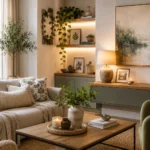

Not every home improvement needs to involve builders, dust sheets, and months of disruption. Some of the most significant transformations come from smaller, more considered changes — a new colour on the walls, a reorganised kitchen, a bathroom refresh, or simply a more thoughtful approach to how a space is lived in. These are the projects that homeowners can often tackle over a weekend or a few weeks, without the upheaval or expense of a major renovation, yet the impact on daily life can be just as profound as a full extension.
This is the quieter side of home improvement — less about square footage and more about atmosphere, function, and feel. It’s the difference between a house that simply contains your belongings and a home that genuinely supports the way you live. In this piece, we look at four areas where modest investment can deliver outsized results: kitchens, bathrooms, colour and decor, and the often-overlooked art of storage and organisation.
The Kitchen Refresh: Updating Without Ripping Out
A full kitchen renovation is one of the more expensive projects a homeowner can take on, which is exactly why the “kitchen refresh” has become such a popular middle-ground option. Rather than tearing out cabinetry entirely, many homeowners are choosing to reface or repaint existing units, swap out worktops, and update handles and hardware — changes that can transform the look of a kitchen at a fraction of the cost of starting from scratch.
Cabinet fronts, in particular, offer excellent value. A professional spray finish in a contemporary colour — sage greens, warm terracottas, and soft charcoals have all seen strong demand recently — can make even a decade-old kitchen feel current. Swapping laminate worktops for a more premium material like quartz or a butcher’s block finish adds a tactile, higher-end feel without the cost of relocating plumbing or altering the kitchen’s layout.
Lighting is another area where relatively small changes yield significant results. Under-cabinet LED strips improve both function and ambience, while replacing a single central ceiling light with a combination of task and accent lighting can make a kitchen feel considerably more sophisticated. Even something as simple as updating tap fixtures or adding an integrated bin system can meaningfully improve the daily experience of using the space — proof that a refresh doesn’t need to be a full renovation to feel transformative.
Bathroom Upgrades: Small Room, Big Opportunity
Bathrooms are often the smallest rooms in the house, but they punch well above their weight when it comes to return on investment. Because the footprint is limited, even modest upgrades can completely change the character of the space, and the cost of materials — tiles, fixtures, paint — is naturally lower simply because there’s less surface area to cover.
Re-grouting and re-sealing tiles is one of the most underrated bathroom improvements available. Discoloured grout can make even a relatively new bathroom look tired, and refreshing it is a low-cost job that instantly lifts the entire room. For those ready to go a step further, replacing a single feature — a dated vanity unit, a shower screen, or an ageing suite — can modernise a bathroom without the need for a full strip-out.
Heated towel rails, improved extraction, and underfloor heating have all moved from luxury add-ons to genuinely popular upgrades, driven by a growing appreciation for the bathroom as a place of daily comfort rather than pure function. Freestanding baths, once reserved for larger period homes, are now being fitted into more compact spaces thanks to smaller, space-saving designs. As with kitchens, lighting plays an outsized role — layered lighting around a mirror, for instance, can make a bathroom feel considerably more polished for a relatively small outlay.
Colour, Texture, and Decor: The Power of the Superficial
It’s easy to underestimate how much a change of colour or texture can do for a room, but decor remains one of the highest-impact, lowest-cost ways to transform a home. Paint alone can shift the entire mood of a space — deep, moody tones create intimacy in a dining room or snug, while lighter, warmer neutrals can make a compact space feel airier and more expansive.
Texture has become just as important as colour in recent interior trends. Textured wallpaper, exposed brick, wood panelling, and boucle or linen upholstery all add depth and tactility to a room, moving interiors away from the flatter, more minimalist aesthetics that dominated the last decade. Layering rugs, cushions, and throws in complementary textures is a simple, low-commitment way to experiment with this trend without a major investment.
Statement pieces — a bold piece of art, an architectural light fixture, or a striking mirror — can also anchor a room and give it a sense of identity, often becoming the focal point around which the rest of the decor is arranged. The beauty of decor-led changes is their reversibility: unlike structural work, a wall colour or a piece of furniture can be swapped out again in a year or two as tastes evolve, making this one of the lowest-risk ways to keep a home feeling current.
Storage and Organisation: The Unsung Hero of Home Living
Of all the changes homeowners can make, few have as much day-to-day impact on quality of life as improved storage. A cluttered, disorganised home creates a low-level sense of stress that many people don’t fully register until it’s gone — and addressing it rarely requires major building work.
Built-in wardrobes, under-stair storage, and bespoke shelving can make dramatic use of previously wasted space, particularly in older properties where storage was never a priority for the original design. Even without built-in solutions, a thoughtful approach to furniture — ottomans with hidden storage, bed frames with drawers, or modular shelving units — can significantly increase a home’s functional capacity.
The kitchen and hallway, as the most heavily trafficked areas of a home, tend to benefit most from organisational upgrades. Pull-out pantry systems, drawer dividers, and dedicated “landing zones” for keys, post, and shoes near the front door can dramatically reduce daily friction. It’s a reminder that not all valuable home improvements are visible ones — sometimes the most meaningful upgrade is simply knowing where everything belongs. For homeowners who split their time between a renovated property and a base elsewhere, planning a second home calls for much the same attention to detail.
Taken together, these smaller-scale changes highlight an important truth about home living: transformation doesn’t always require a builder’s van outside for six weeks. Thoughtful, incremental improvements — a refreshed kitchen, an upgraded bathroom, a considered colour palette, and better organisation — can collectively reshape how a home feels and functions, often for a fraction of the cost and disruption of a major renovation.